Sonali Andani, MSc
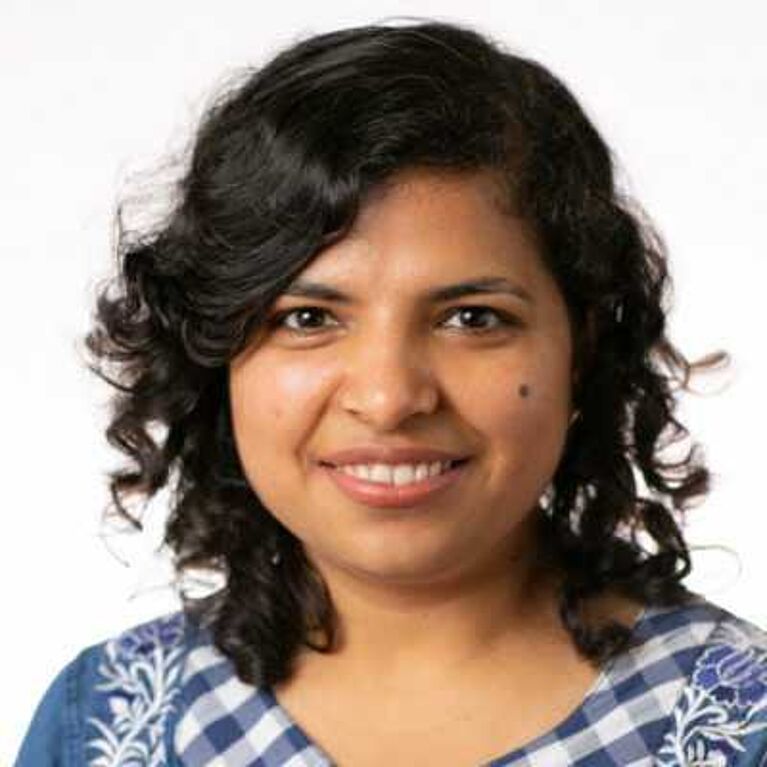
PhD Student
- andanis@ethz.ch
- Address
-
Biomedical Informatics Group
Schmelzbergstrasse 26
SHM 26 B 5
8006 Zürich - Room
- SHM 26 B 5
My interest lies in understanding cancer from multiple data modality perspectives, using novel machine learning-based methods that can help in better diagnosis and prognosis of cancer.
I did my undergraduate degree in electrical engineering at VIT Vellore, India. Then I went to ETH Zürich for my master's in robotics with a focus on machine learning, computer vision and image processing. During and after my masters I worked with the Computational pathology team in IBM Zurich Research Lab for two years, applying machine learning methods to understand cancer imaging datasets. Since September 2019 I have been working jointly between the Biomedical Informatics group and the University Hospital of Zurich on multi-modal data analysis of cancer.
Latest Publications
Abstract Spatial transcriptomics technology remains resource-intensive and unlikely to be routinely adopted for patient care soon. This hinders the development of novel precision medicine solutions and, more importantly, limits the translation of research findings to patient treatment. Here, we present DeepSpot, a deep-set neural network that leverages recent foundation models in pathology and spatial multi-level tissue context to effectively predict spatial transcriptomics from H&E images. DeepSpot substantially improved gene correlations across multiple datasets from patients with metastatic melanoma, kidney, lung, or colon cancers as compared to previous state-of-the-art. Using DeepSpot, we generated 1 792 TCGA spatial transcriptomics samples (37 million spots) of the melanoma and renal cell cancer cohorts. We anticipate this to be a valuable resource for biological discovery and a benchmark for evaluating spatial transcriptomics models. We hope that DeepSpot and this dataset will stimulate further advancements in computational spatial transcriptomics analysis.
Authors Kalin Nonchev, Sebastian Dawo, Karina Selina, Holger Moch, Sonali Andani, Tumor Profiler Consortium, Viktor Hendrik Koelzer, and Gunnar Rätsch
Submitted MedRxiv
Abstract Spatial transcriptomics enables in-depth molecular characterization of samples on a morphology and RNA level while preserving spatial location. Integrating the resulting multi-modal data is an unsolved problem, and developing new solutions in precision medicine depends on improved methodologies. Here, we introduce AESTETIK, a convolutional deep learning model that jointly integrates spatial, transcriptomics, and morphology information to learn accurate spot representations. AESTETIK yielded substantially improved cluster assignments on widely adopted technology platforms (e.g., 10x Genomics™, NanoString™) across multiple datasets. We achieved performance enhancement on structured tissues (e.g., brain) with a 21% increase in median ARI over previous state-of-the-art methods. Notably, AESTETIK also demonstrated superior performance on cancer tissues with heterogeneous cell populations, showing a two-fold increase in breast cancer, 79% in melanoma, and 21% in liver cancer. We expect that these advances will enable a multi-modal understanding of key biological processes.
Authors Kalin Nonchev, Sonali Andani, Joanna Ficek-Pascual, Marta Nowak, Bettina Sobottka, Tumor Profiler Consortium, Viktor Hendrik Koelzer, and Gunnar Rätsch
Submitted MedRxiv
Authors Sarah Volinsky-Fremond, Nanda Horeweg, Sonali Andani, Jurriaan Barkey Wolf, Maxime W. Lafarge, Cor D. de Kroon, Gitte Ørtoft, Estrid Høgdall, Jouke Dijkstra, Jan J. Jobsen, Ludy C. H. W. Lutgens, Melanie E. Powell, Linda R. Mileshkin, Helen Mackay, Alexandra Leary, Dionyssios Katsaros, Hans W. Nijman, Stephanie M. de Boer, Remi A. Nout, Marco de Bruyn, David Church, Vincent T. H. B. M. Smit, Carien L. Creutzberg, Viktor H. Koelzer & Tjalling Bosse
Submitted Nature Medicine
Authors Sonali Andani, Boqi Chen, Joanna Ficek-Pascual, Simon Heinke, Ruben Casanova, Bettina Sobottka, Bernd Bodenmiller, Tumor Profiler Consortium, Viktor H Kölzer, Gunnar Rätsch
Submitted medRxiv
Authors Nikolaos Papandreou, Sonali Andani, Andreea Anghel, Milos Stanisavljevic
Submitted US Patent 16822136
Authors Sarah Fremond, Sonali Andani, Jurriaan Barkey Wolf, Jouke Dijkstra, Sinéad Melsbach, Jan J. Jobsen, Mariel Brinkhuis, Suzan Roothaan, Ina Jurgenliemk-Schulz, Ludy CHW. Lutgens, Remi A. Nout, Elzbieta M. van der Steen-Banasik, Stephanie M. de Boer, Melanie E. Powell, Naveena Singh, Linda R. Mileshkin, Helen J. Mackay, Alexandra Leary, Hans W. Nijman, Vincent T.H.B.M. Smit, Carien L. Creutzberg, Nanda Horeweg, Viktor H Koelzer, Tjalling Bosse
Submitted The Lancet Digital Health (accepted)
Abstract The application and integration of molecular profiling technologies create novel opportunities for personalized medicine. Here, we introduce the Tumor Profiler Study, an observational trial combining a prospective diagnostic approach to assess the relevance of in-depth tumor profiling to support clinical decision-making with an exploratory approach to improve the biological understanding of the disease.
Authors Anja Irmisch, Ximena Bonilla, Stéphane Chevrier, Kjong-Van Lehmann, Franziska Singer, Nora C. Toussaint, Cinzia Esposito, Julien Mena, Emanuela S. Milani, Ruben Casanova, Daniel J. Stekhoven, Rebekka Wegmann, Francis Jacob, Bettina Sobottka, Sandra Goetze, Jack Kuipers, Jacobo Sarabia del Castillo, Michael Prummer, Mustafa A. Tuncel, Ulrike Menzel, Andrea Jacobs, Stefanie Engler, Sujana Sivapatham, Anja L. Frei, Gabriele Gut, Joanna Ficek-Pascual, Nicola Miglino, Melike Ak, Faisal S. Al-Quaddoomi, Jonas Albinus, Ilaria Alborelli, Sonali Andani, Per-Olof Attinger, Daniel Baumhoer, Beatrice Beck-Schimmer, Lara Bernasconi, Anne Bertolini, Natalia Chicherova, Maya D'Costa, Esther Danenberg, Natalie Davidson, Monica-Andreea Drăgan, Martin Erkens, Katja Eschbach, André Fedier, Pedro Ferreira, Bruno Frey, Linda Grob, Detlef Günther, Martina Haberecker, Pirmin Haeuptle, Sylvia Herter, Rene Holtackers, Tamara Huesser, Tim M. Jaeger, Katharina Jahn, Alva R. James, Philip M. Jermann, André Kahles, Abdullah Kahraman, Werner Kuebler, Christian P. Kunze, Christian Kurzeder, Sebastian Lugert, Gerd Maass, Philipp Markolin, Julian M. Metzler, Simone Muenst, Riccardo Murri, Charlotte K.Y. Ng, Stefan Nicolet, Marta Nowak, Patrick G.A. Pedrioli, Salvatore Piscuoglio, Mathilde Ritter, Christian Rommel, María L. Rosano-González, Natascha Santacroce, Ramona Schlenker, Petra C. Schwalie, Severin Schwan, Tobias Schär, Gabriela Senti, Vipin T. Sreedharan, Stefan Stark, Tinu M. Thomas, Vinko Tosevski, Marina Tusup, Audrey Van Drogen, Marcus Vetter, Tatjana Vlajnic, Sandra Weber, Walter P. Weber, Michael Weller, Fabian Wendt, Norbert Wey, Mattheus H.E. Wildschut, Shuqing Yu, Johanna Ziegler, Marc Zimmermann, Martin Zoche, Gregor Zuend, Rudolf Aebersold, Marina Bacac, Niko Beerenwinkel, Christian Beisel, Bernd Bodenmiller, Reinhard Dummer, Viola Heinzelmann-Schwarz, Viktor H. Koelzer, Markus G. Manz, Holger Moch, Lucas Pelkmans, Berend Snijder, Alexandre P.A. Theocharides, Markus Tolnay, Andreas Wicki, Bernd Wollscheid, Gunnar Rätsch, Mitchell P. Levesque
Submitted Cancer Cell (Commentary)